A small red mark can carry very different meanings. At the edge of a painting, it may identify an artist. Inside a book, it may mark ownership. On a historical document, it may express institutional authority. These objects and impressions belong to the broad world of seals, but their purposes should not be treated as interchangeable.
If your first encounter with a Korean seal is a digital image of your own name, the most useful thing to know first is what that image is not. The short answer: a digital Hangul seal is a keepsake picture of your name, not a registered seal, and it cannot replace a signature or an official stamp. The next section explains the three things people mean by a "Korean seal", and the rest of the guide looks at the history that makes them interesting.
A few useful words
Dojang, written 도장, is a common Korean word for a stamp or seal. Injang, 인장, is another term associated with seals. The physical object and the mark it leaves are worth distinguishing: inyeong, 인영, refers to the impression. An attractive engraved surface does not automatically produce a clear impression at a small size.
For a beginner, that distinction has a practical consequence. When evaluating a physical seal, look at the printed result, not just a photograph of its handle. With a digital seal, inspect the image at the size where you will actually use it. Fine details that look elegant when enlarged can merge when reduced.
What royal seals can tell us
Korea's royal seal traditions involved more than a ruler stamping routine paperwork. The National Palace Museum of Korea introduces eobo, royal ceremonial seals, in its online exhibition on Joseon royal seals. Their role in royal ceremonies is central to understanding them. They could express status and commemorate titles, rather than functioning simply as everyday signatures.
The exhibition also draws attention to physical components, including the handle, body, inscription, and impression. This is a helpful way to look closely at an object. A visitor can ask who the seal concerned, why it was made, and what its inscription expressed, instead of focusing only on whether its material looks expensive.
The broader history also includes state seals used in government contexts. A ceremonial royal seal and a state seal should not automatically be given the same description. Purpose matters. When reading a museum label, the intended use often explains more than a modern analogy such as “the king's signature stamp.”
Historical objects are especially interesting when you resist imagining that every seal served one timeless function. A title, occasion, institution, or owner could shape what a seal meant. That diversity provides context for modern personal seals without implying that a decorative image has inherited royal authority.
Seals in art and personal life
In the context of painting and calligraphy, nakgwan refers to the signing and sealing of work. The mark can contribute to the composition as well as identifying the maker. Its placement, scale, and color affect how the eye moves across a page. A large red impression in a narrow margin can dominate the work instead of completing it.
For a personal project, think about what you want the mark to communicate. A fictional visitor named Emma might want a Korean-name seal for a travel journal. A small, legible image beside the date could suit that purpose better than an elaborate design occupying half the page. Another person might use a name seal on a language-study notebook to mark a new stage in learning Korean.
These examples are suggested uses, not accounts of actual customers. Their point is that the best size and layout depend on the setting. A keepsake letter, a book label, and an art composition place different demands on the same name.
Dojang, ingam and a digital seal: what each one is
Three quite different things get called a Korean seal, and mixing them up is the most common mistake visitors make.
- Dojang (도장) is any personal name stamp. Many Koreans own an ordinary one and have used it for everyday paperwork that accepts a stamp in place of a signature. It is not registered anywhere, and today a signature is accepted for most of those tasks.
- Ingam (인감) is a seal whose impression the owner has registered in person at the local community service centre (주민센터). When a transaction needs proof, the owner asks for an ingam certificate (인감증명서), which confirms that the stamp on a document matches the registered impression. It is kept for weighty matters such as selling property or a car. Since December 2012 a certificate of personal signature (본인서명사실확인서) can be used instead in many of the same situations.
- A digital Hangul seal is an image of a name inside a seal frame, like the one K-Soul Seal draws. It is a picture. It cannot be registered, it carries no legal weight, and it is not a substitute for a signature, an ingam or any official stamp.
A seal does not become an ingam because it looks traditional, is carved by hand or contains a full name. Registration is what makes it one, and registration is tied to Korean resident or foreign-resident records and to the office for your address, so a short-term visitor cannot register one. If you live in Korea and need an ingam, ask that office about its requirements before having a seal made, and do not assume a decorative seal, including ours, will be accepted. The handmade boxwood seal in our shop is engraved with the Hangul you choose and is sold as a decorative name seal, not as an ingam.
What K-Soul Seal actually displays
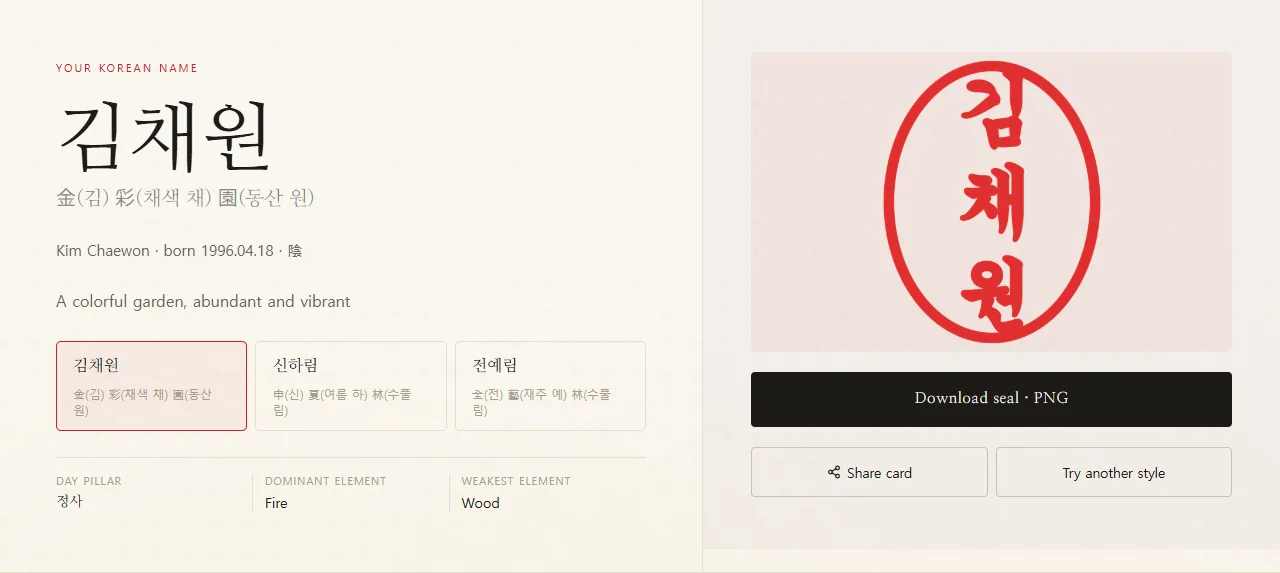
K-Soul Seal's digital dojang uses the Korean name in Hangul, the Korean alphabet. In the result above, the name card lists the hanja 金彩園 with their meanings, while the seal itself reads 김채원 in Hangul. Its lettering is rendered from a Gungseo-style font and arranged inside a seal frame. The hanja discussed in a name's meaning explanation are separate from the letters displayed on this digital seal.
Suppose you choose Jiwoo and associate it with 智, wisdom, and 佑, help. The image should still be checked against the selected Hangul spelling, 지우, along with any surname shown. Looking for 智佑 inside the seal would be checking for the wrong script. A short explanation beside the image can introduce the hanja meanings without claiming that those characters are engraved there.
Digital rendering is also different from hand carving a physical block. A brush-inspired font can create a particular visual style, but the image should not be described as an antique, a royal artifact, or a hand-carved original.
Plan a useful first application
Before adding your image to a letter or notebook page, verify every Hangul syllable against the name result. Ask a Korean speaker to help if you cannot yet distinguish the letters. Then test the image on the intended background at its final size. Check that the lettering remains readable and the frame does not crowd nearby text.
For a gift, consider adding a small card with the Hangul name, romanization, and your reason for choosing it. That gives the recipient something to read and discuss beyond the decorative mark. If buying a physical product, check its specific lettering options rather than assuming it matches the site's digital version.
The About page explains the site's naming and seal process. A personal dojang can be a thoughtful point of contact with Korean naming culture when its lettering, purpose, and explanation are clear. Its value as a keepsake can come from your chosen name and the occasion you connect with it.