Most people meet a Korean name in the Latin alphabet first: on a class list, a K-drama credit, an email signature. The trouble is that romanization was designed to write Korean down consistently, not to tell an English speaker how to say it. Seoyeon looks like four or five syllables and is really two. Gunwoo looks like "gun" plus "woo" and is said almost as one smooth word.
This guide covers the handful of rules that fix most mistakes. The respellings used here, such as suh-yuhn for Seoyeon, are the same ones shown in the "How to pronounce" box on each of our name pages. They are worked out by rule from the Hangul spelling, not recorded from a speaker, so treat them as a close approximation of standard Seoul speech.
Count the Hangul blocks, not the letters
Every Korean syllable is written as one square block. 서연 is two blocks, so Seoyeon is two syllables: suh-yuhn. 지우 is two blocks, so Jiwoo is jee-oo, not "jee-woo" with a strong w. If you can see the Hangul, counting the blocks tells you the rhythm before you say anything.
Then give each block roughly the same weight. English stresses one syllable heavily, which turns Jiwoo into "JEE-woo" or "jee-WOO". Korean keeps the beats even. Saying both syllables at the same volume and length already sounds more natural than getting every vowel exactly right.
The vowels that romanization hides
- eo is "uh", as in sun. Seoyeon is suh-yuhn, Jaehyun is jeh-hyuhn, and Jeonga is juhng-ah. It is never "ee-oh".
- eu has no English match. Say "oo" with your lips relaxed and spread instead of rounded. Eunseo is eun-suh, Seulgi is seul-gee.
- ae and e are the same sound in modern Seoul Korean, like the e in bed. Taemin and Chaerin start with teh and cheh.
- o is a pure rounded "oh", without the w glide English adds to go. Doyun is doh-yoon.
- i is always "ee". Minjae is meen-jeh, not "min-jay".
These five cover almost every name in our dictionary. If a name surprises you, it is usually one of them.
When a consonant moves to the next syllable
Korean likes to run syllables together. When a syllable ends in a consonant and the next one begins with the silent ㅇ, that final consonant slides forward and starts the next syllable.
- Gunwoo, 건우, is said guh-noo: the n of 건 moves over to 우.
- Minah, 민아, is mee-nah, and Euna, 은아, is eu-nah.
- Chanyoung, 찬영, is chah-nyuhng, and Onyu, 온유, is oh-nyoo.
- Byeola, 별아, is byuh-rah: the l moves forward and becomes the light tapped r described below.
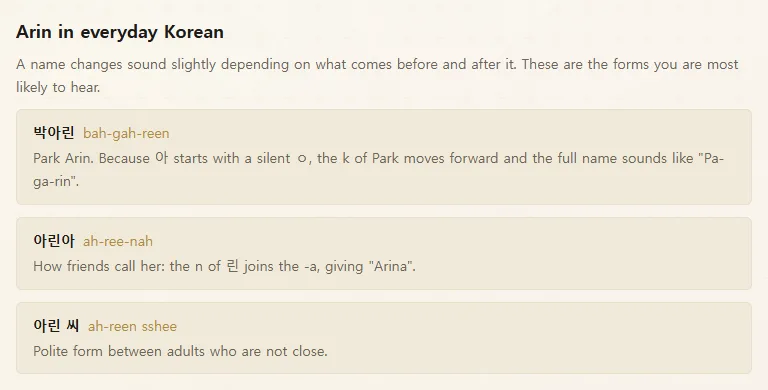
This also happens across the surname. Park Arin, 박아린, is said bah-gah-reen, because the k of Park moves onto 아 and softens. Arin's friends calling her 아린아 say ah-ree-nah. Neither change appears in the spelling.
r, l and the tapped sound
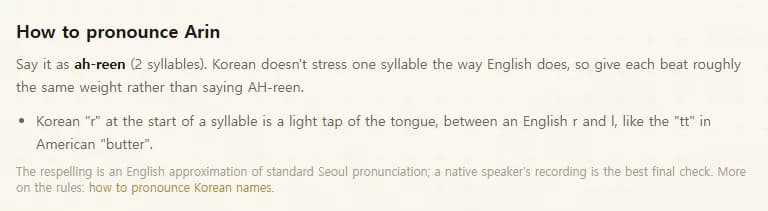
Korean has one letter, ㄹ, where English has both r and l. Between vowels it is a quick tap of the tongue, close to the tt in American butter. That is the sound in Yerin (yeh-reen), Arin and Bora. At the end of a syllable it is a clear l: Hanbyeol ends in byuhl, Eunsol in sohl.
When two ㄹ meet, or ㄴ meets ㄹ, you hear a held "ll" instead of an n. The name pages flag this when it applies.
Consonants that are softer or harder than they look
At the very start of a name, g, d, b and j are lighter than in English, halfway toward k, t, p and ch. So Jiwoo begins with something between "j" and "ch", and Doyun with something between "d" and "t". Do not overcorrect into a hard k or t; just relax the sound.
Some names change in the other direction depending on what comes before. After a k, p or t sound, a following g, d, b, s or j becomes tense: Park Jiwoo, 박지우, is said bahk-jjee-oo. And an h after n, m, ng or l often nearly disappears in natural speech, so Junho can sound close to joo-noh, and Eunho close to eu-noh.
s before i sounds like sh
A Korean s before an "ee" or a "y" sound is said closer to English sh. Sia is shee-ah, Siwoo shee-oo, and Yeongsik ends in sheek. Many visitors are surprised by this one, but every Korean speaker does it.
Surnames you will meet constantly
The common surnames have well-known spellings that do not match their sound:
- Lee (이) is just ee. There is no l sound at the start in South Korean speech.
- Park (박) is bahk, with no r and a soft p.
- Kim (김) starts between g and k.
- Choi (최) is close to chweh, not "choy".
- Jung or Jeong (정) is juhng.
Remember that Korean puts the surname first. In 김지우, Kim is the family name and Jiwoo is the given name.
What this guide cannot do
A rule-based respelling is a starting point. It cannot show pitch or rhythm, and speakers outside Seoul pronounce some vowels differently. Our respellings also ignore some rare sound changes. If the name matters to you, ask a Korean speaker to say it once, or listen to a dictionary recording of the same Hangul.
Spelling is a separate decision. Jiwoo, Ji-woo, Jiu and Jiwu are all the same 지우. Our guide to English and Korean name forms explains how to pick a romanization you are comfortable with, and choosing hanja covers the written meaning.
Try it on your own name
Every name you receive on K-Soul Seal comes with its Hangul spelling, a romanization and the meaning of each character. The romanization is a spelling, not a pronunciation, so run it through the rules above: count the blocks, check the vowels, and look for a consonant that moves. The name dictionary has a pronunciation box for each indexed name if yours is there. Start with a familiar one such as Jiwoo, Yerin or Arin, then create your own Korean name and practise it aloud until it feels like yours.